Custom software vs off-the-shelf: what it is, pros and cons, and when each makes sense
What custom software and off-the-shelf (COTS) software are, their real pros and cons, examples, and how to decide which one fits your company now that license prices keep rising and AI has changed how software gets built.
Over the last few months I've heard the same question in almost every conversation with business owners and operations leaders: should we buy a tool that already exists, or should we build custom software? The question isn't new, but the context has changed. On one side, license prices for off-the-shelf tools keep going up every year; on the other, AI has made building software faster and cheaper than ever. With both happening at once, it's easy to make the right call for the wrong reason.
In this article I'll walk you through what each option is, the real pros and cons, a few examples and, most importantly, how to tell which one makes sense for your company.
What is custom software?
Custom software (in the UK and in many proposals you'll also see it called bespoke software) is a system built for one specific company's process: its rules, its approvals, its documents and the way its people actually work. You don't buy it off a shelf or rent it per seat; it's designed and built, and the company ends up with a system that fits its operation.
Its main characteristics are three: it's built on the real process (not an average one), it can connect to the systems the company already runs, and it can evolve when the business changes, because the code and the decisions belong to the company.
What is off-the-shelf software (COTS)?
Off-the-shelf software, also called COTS (commercial off-the-shelf), is a product built for many companies at once. You buy it or, far more often today, pay a monthly subscription per user: a CRM, an ERP, an invoicing, inventory or project management tool. You configure it, but you don't change how it works inside; your company adapts to the way the tool solves the problem.
Pros and cons of off-the-shelf software
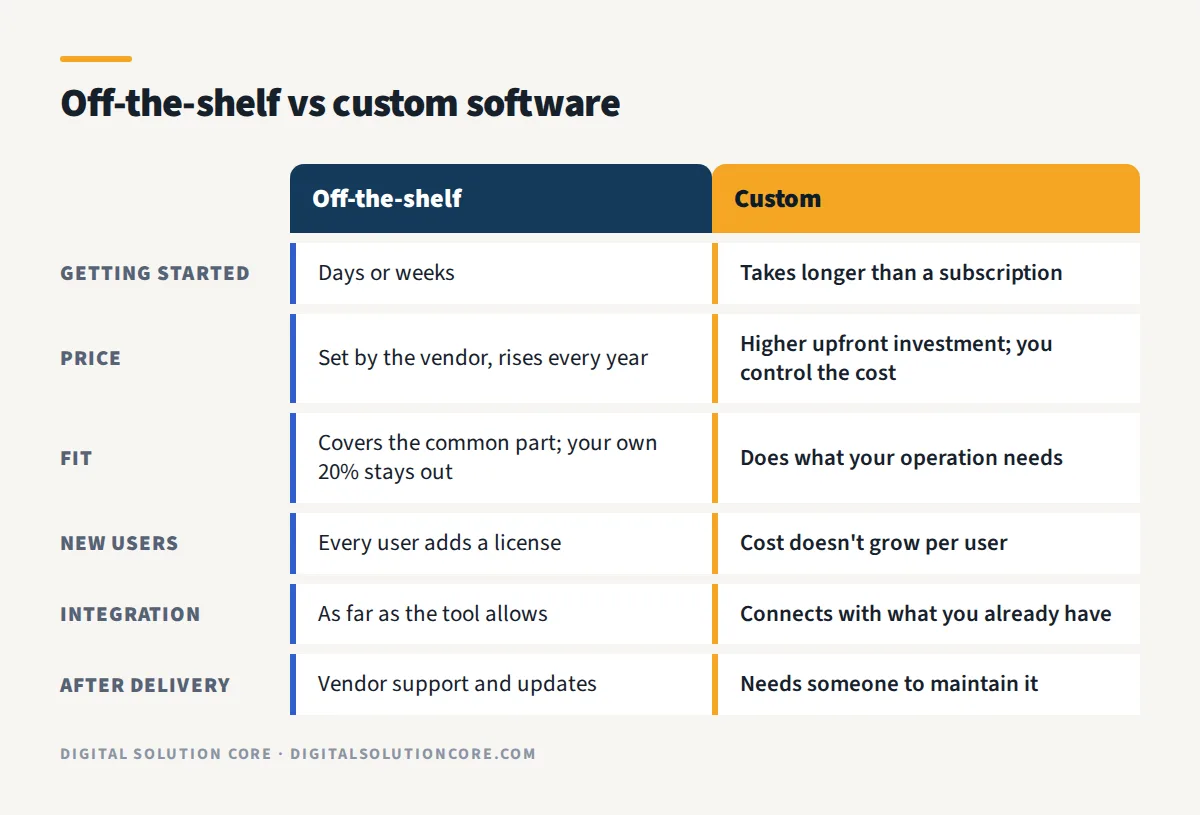
The big advantage is speed: in days or weeks the tool is up and running, with support, updates and a user community behind it. For processes that look the same in almost every company (accounting, payroll, email), in my experience it's the right call nearly every time.
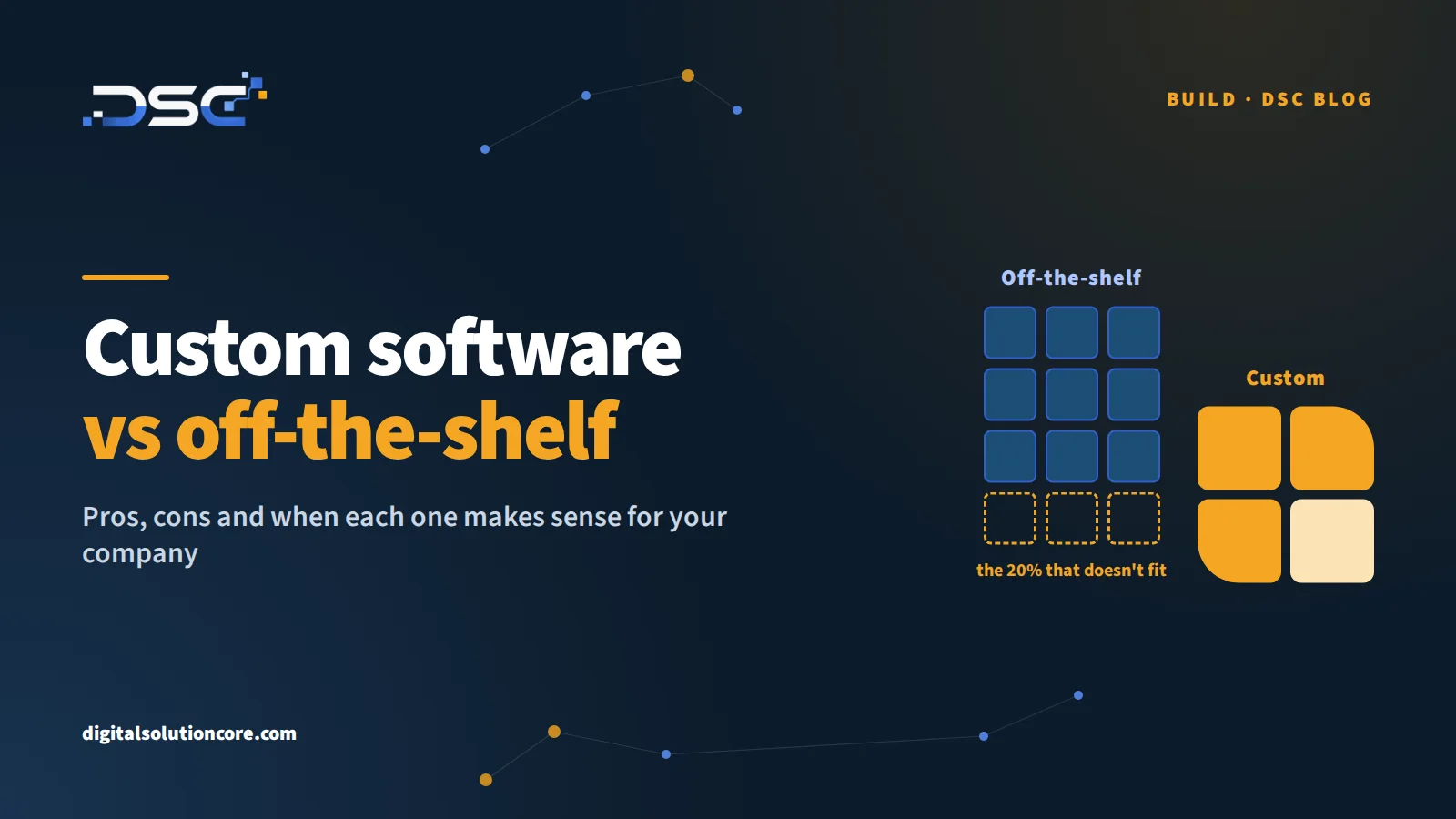
The downsides show up over time. First, you don't control the price: Zylo's 2026 SaaS Management Index, covered by CFO Dive on January 29, 2026, notes that Salesforce raised prices on its core clouds by 6% on average in August 2025 and that Slack's Business+ plan went up 20%. Second, there's the 20% that doesn't fit: the part of your process the tool doesn't cover, which ends up in spreadsheets, email threads and double data entry (with all the errors that come with it). Third, your data ends up spread across tools that don't talk to each other.
Pros and cons of custom software
The main advantage is fit: the system does what your operation needs, you don't pay for features nobody uses, and people don't have to work around the tool. Costs also don't grow with every new seat, and the system can integrate with what you already have. When the process is core to your business, the thing that sets you apart from competitors, that's the strongest reason to build.
The downsides are real too, and they should be said out loud: the upfront investment is higher, it takes longer than turning on a subscription, and someone has to maintain it after launch. There's also a risk I've seen many times leading projects: if nobody took the time to really understand the process before building, the software ends up automating the mess.
If you'd like to see how we approach these projects at DSC, here's our take on custom software development.
What changed with AI
You hear a lot that AI has cut the cost and time of building software, and it's true: Stack Overflow's 2025 Developer Survey found that 84% of respondents are using or planning to use AI tools in their development process. We use it every day, and it lets us build faster.
What AI doesn't do on its own is understand your business. Writing code is no longer the expensive part of a project; the expensive part is still understanding the process, deciding what to build and what not to, and proving it works in day-to-day operations. Without that groundwork, AI only helps you build something that doesn't fit, faster.
So here's how I read this moment: building custom is more within reach than it was a few years ago for well-defined problems, and off-the-shelf licenses take a bigger bite out of the budget every year, but neither one replaces the work of understanding the business first.
Examples to ground the decision
Some typical cases where off-the-shelf is usually enough: accounting and invoicing, email and office tools, a basic CRM for a small sales team.
Cases where custom software usually makes more sense: an approval workflow with its own rules that lives in email today, an operation that needs to pull data from three or four systems into one place, a service process that is exactly what your customers value about you, or an off-the-shelf tool where you pay for a lot of seats to use a small slice of it.
And there's a middle ground that rarely gets mentioned: keep the off-the-shelf tool and build only the integration or the missing piece.
How to tell which one fits your company
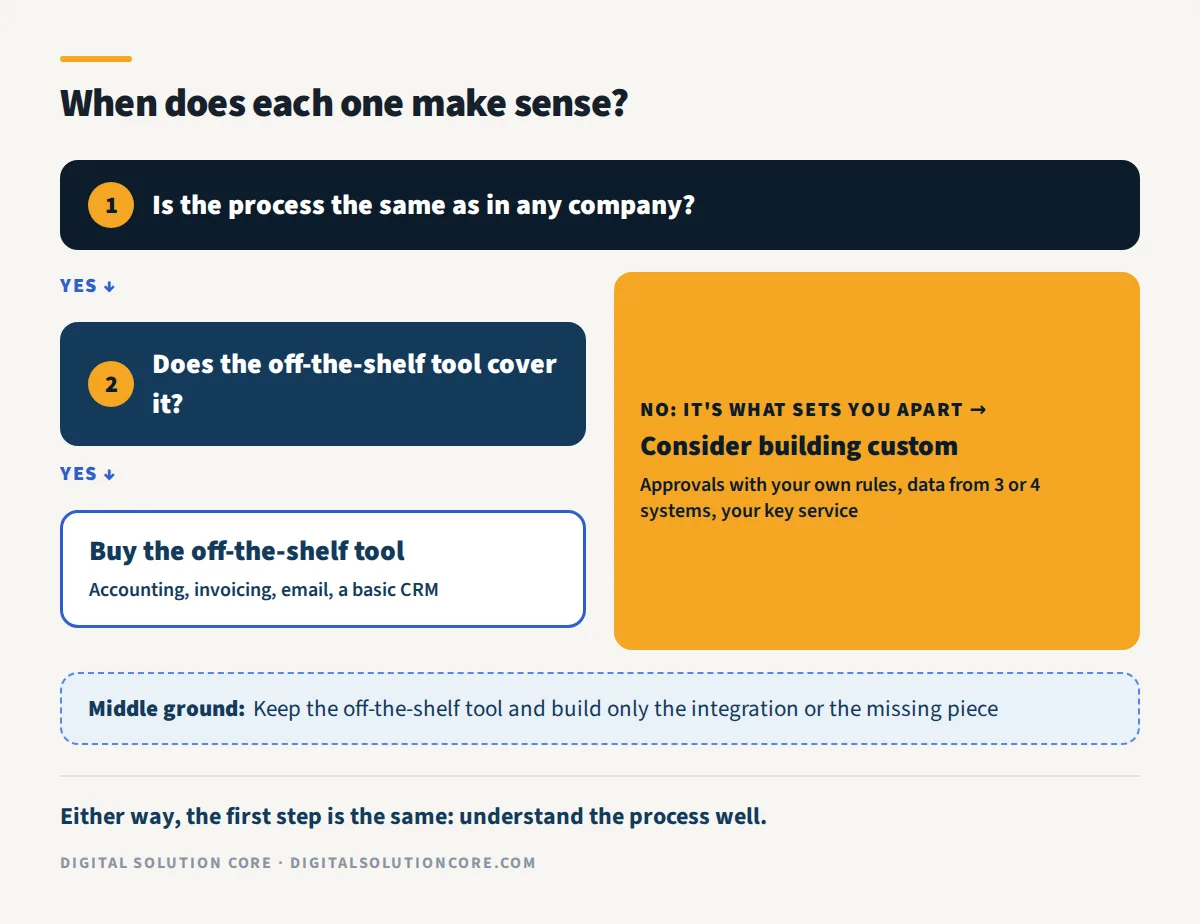
Before you ask for quotes, I'd suggest answering these questions with the people who run the process every day:
- Is this process the same as in any other company, or is it part of what makes us different?
- Which part of the process happens outside our tools today (spreadsheets, email, chat)?
- How much do we pay per year in licenses for this, and how much has that grown in the last two years?
- Which other systems does it need to talk to?
- Which operating metric should improve if we make the right call?
If the process is standard and the tool covers it, buy the tool, no drama. If your answers show the value sits in the part no tool solves, it's worth looking at building. Either way, the first step is the same: understand the process well. In the article on requirements gathering I explain how to do it.
If you'd like to look at your case with us, you can request a free assessment and we'll go through it together. In your company, what's the 20% no tool has been able to solve?
Sources
- Zylo, 2026 SaaS Management Index, covered by CFO Dive (January 29, 2026): Enterprise software bills climb amid AI pricing volatility.
- Stack Overflow, 2025 Developer Survey, AI section: survey.stackoverflow.co/2025/ai.